Bygone

Road stories for the places you pass

“I wonder what that was.” Now you get to find out.

For years my dad and I drove past ghost towns, ruins and buildings with no name on them, and wondered what had happened there. I built Bygone to answer us. It finds the past of the place you are passing and tells you the story out loud, on the highway or on foot. Put the phone down and listen.

▶  Hear a story Why I built it

Bygone for iPhone is in beta testing now. The Android version follows. United States first.

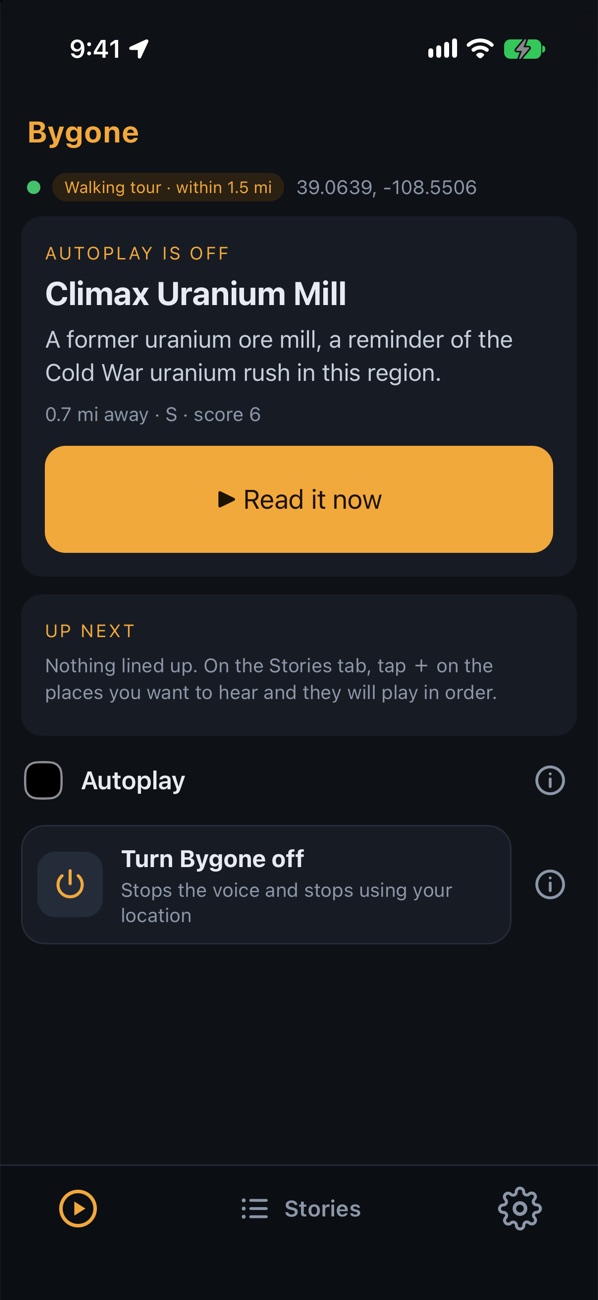
The Bygone app's Play screen: the next place, Climax Uranium Mill, with a Read it now button

Where this came from

My dad and I have taken a lot of road trips together. Somewhere on every one of them he points out the window at something we are passing, a foundation in the sagebrush, a row of empty buildings, a road cut into a hillside for no reason we can see, and wonders out loud what it was. Then we both come up with theories. Most of them are probably wrong, and we never find out.

He is 78 now, and looking things like that up is not something he can do. And the truth is that even when I look, I do not always find what I am after. A search gives you a name and a date, if you are lucky. It does not tell you what happened there.

So I built the thing I wished we had. Bygone knows where you are and finds what is worth knowing about around you. Then it does the research I wish I could do: it searches out what has been written about a place, reads it, and pieces together what actually happened there, in a way no single search ever gave me. A guide tells it to you while the place is still outside your window.

We tried an early version on US-50 across Nevada, the one they call the Loneliest Road in America. There is nothing out there. We looked out the windows at mile after mile of empty country, and we listened. Pony Express riders and Wells Fargo stages. The settlers, and the towns that crumbled because somebody’s prediction turned out wrong. Internment camps and prisoner-of-war camps. Crimes. Atomic tests and Air Force bases. The faults running under the valleys. The Native people who crossed that land long before there was a road, and the Spanish explorers who came after them. Almost none of it has a sign. All of it was right there.

That is what I want Bygone to give you. It is not only the historical markers. It is the past of everything around you, the context that turns a boring road into somewhere. These are the stories I would have expected only a real historian to find, and they were waiting beside the highway the whole time.

My dad still points out the window. Now we find out.

Ryan

How it works

I wanted it to work for someone who never opens a settings screen. So there is nothing to set up. Open Bygone, let it use your location, and it starts looking.

  1. It looks around you

    On a highway, Bygone looks down the road ahead of you. In town or on foot, it looks all around. It works out which by itself from how you are moving.

  2. It finds what is worth a story

    Named peaks, mining camps, railroad depots, dams, outlaws, forts, fossils, and the place you would have driven past without a second look. Each one gets a line about why it matters, so you can choose, or let Autoplay choose for you.

  3. A guide tells it

    A story runs three or four minutes, told by the guide you picked, and it tells you which side of the road to look on. Every story lists where it came from.

Hear one

I could describe it all day, but it is easier to listen. This is a real Bygone story, exactly as the app tells it on the edge of Grand Junction, Colorado: the ghost town of Carpenter, under the Book Cliffs. Press play, then hear the same place from a very different guide.

Hear it from all five guides, and more stories with their scripts and sources

What you can do with it

Everything here started as something we wanted in the car.

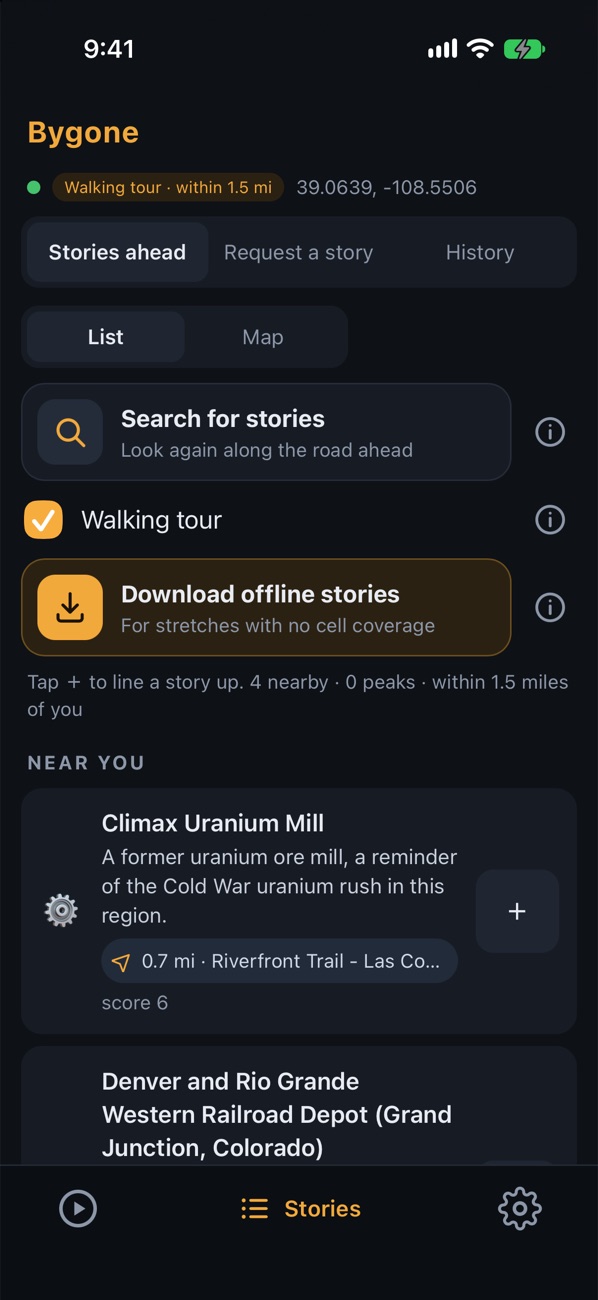
The Stories screen: a list of nearby places with distance, street address and a plus button to line each one up

Stories ahead, driving or walking

The Stories tab lists what is coming up: how far, which side, and a line about why it matters. Tap + to line stories up in the order you want, or switch on Autoplay and Bygone starts the next good one by itself as you approach, so nobody has to touch the phone.

  • On the road: the stretch ahead of you, up to 60 miles.
  • In town: everything within six miles.
  • Walking tour: one switch narrows it to about a mile and a half and shows street addresses.
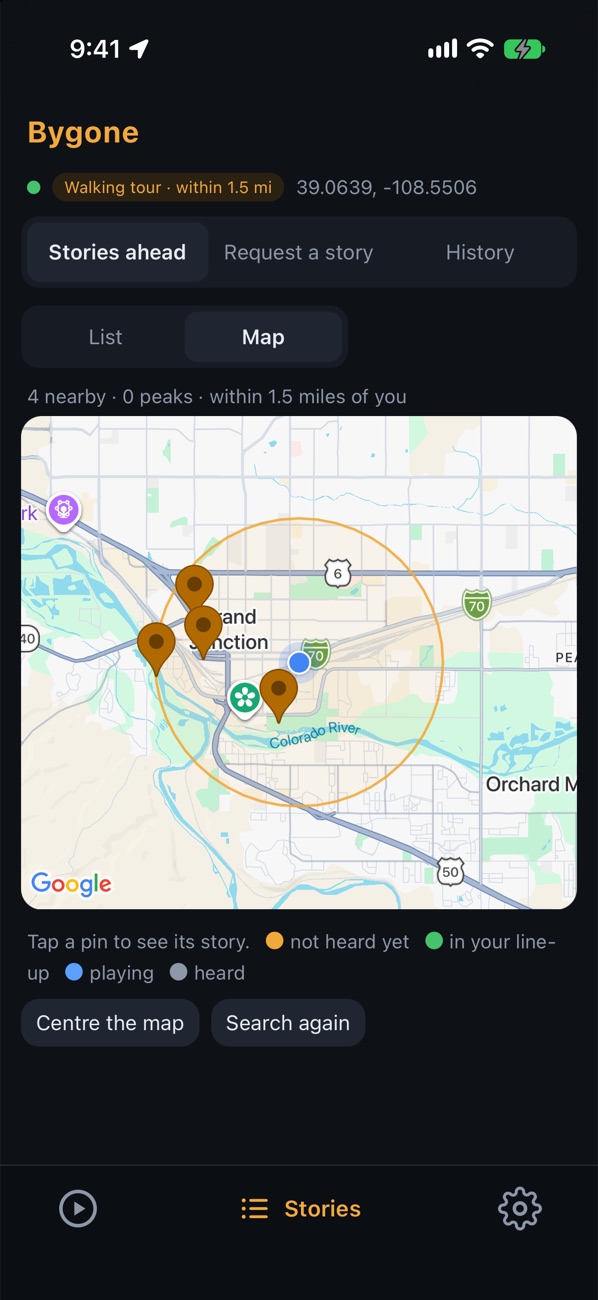
The map view: pins for nearby story places around the listener in Grand Junction, Colorado

See it on a map, and get directions

Switch the list to a map to see every story place around you. Tap the distance on any place and Bygone hands it to Apple Maps or Google Maps for walking or driving directions. You choose which maps app it uses.

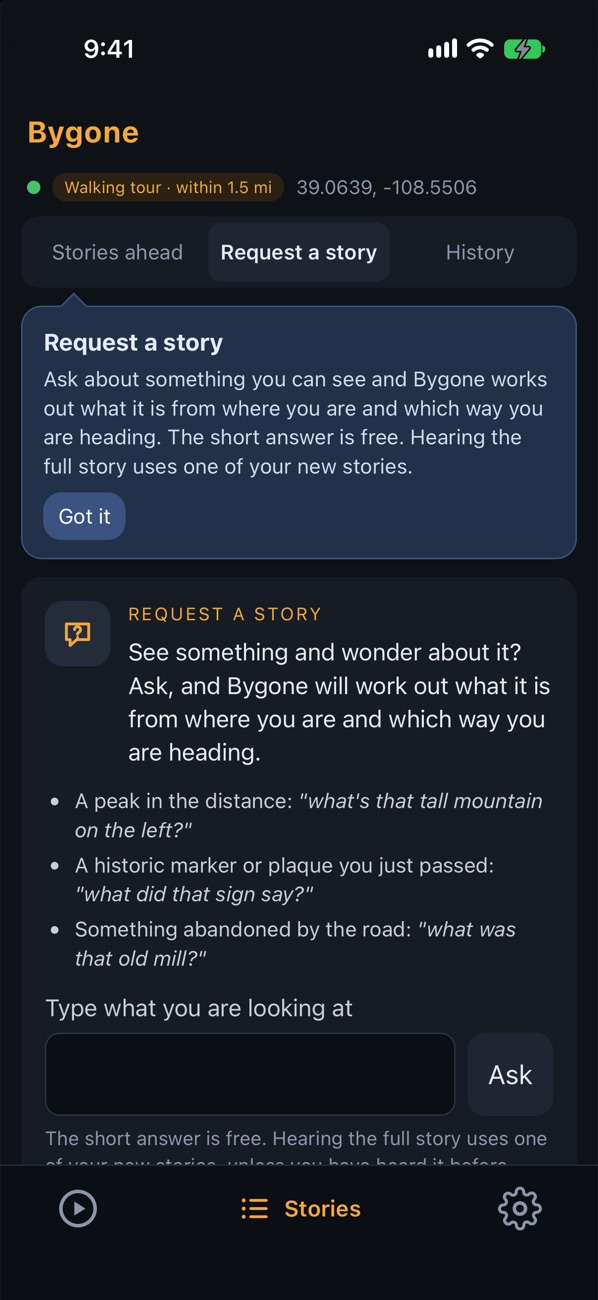
The Request a story screen: a box to type what you are looking at, with example questions

Request a story: “What’s that peak?”

This is the one my dad would use. See something and wonder about it? Ask. Bygone works out what you mean from where you are and which way you are heading: the tall mountain on the left, the plaque you just passed, the ruin by the road. The short answer is free, and you can hear the full story if you want it.

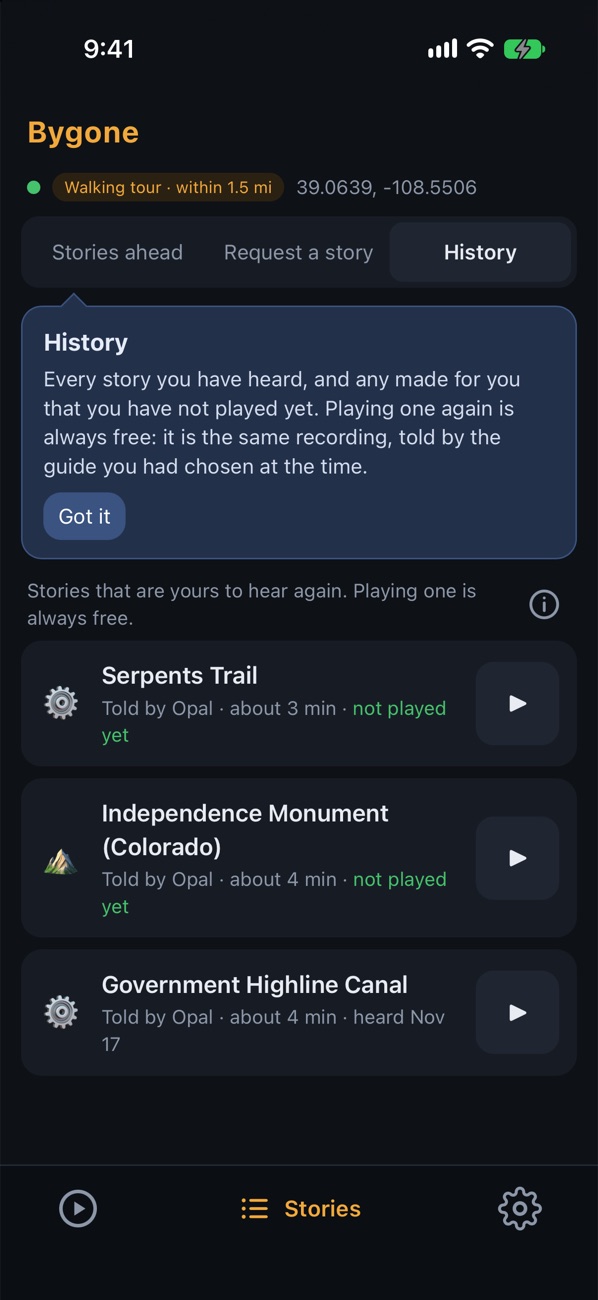
The History screen: stories already heard, each with a play button

Offline stories for the empty stretches

The best country often has no cell coverage, and the emptiest roads are where you most want a story. Before you lose signal, tell Bygone where your trip ends, pick a route and how far along it to go, and choose which stories to download. They then play by GPS alone, with no connection at all.

Bygone can also open your maps app at the right place so you can download an offline map for the same stretch.

Hear it again, free

Every story you have heard is kept in History. Playing one again never costs anything: it is the same recording, told by the guide you had chosen.

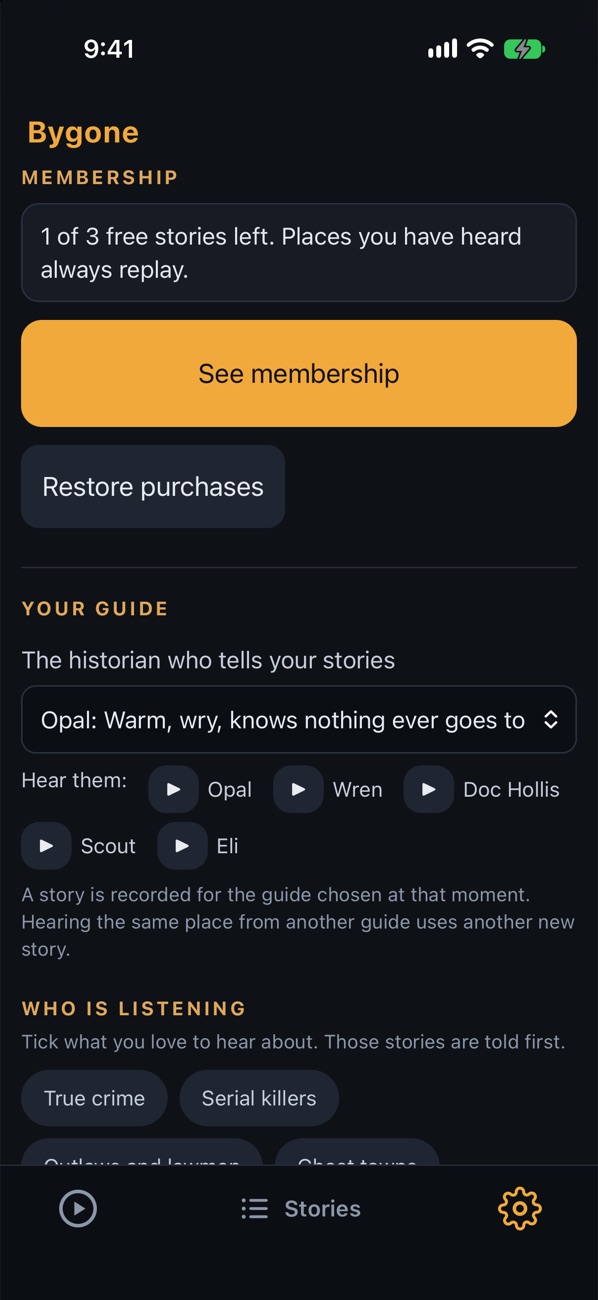
The Setup screen: free stories left, the choice of guide with buttons to hear each one, and interests to tick

Stories that know who is listening

Tick what you love to hear about, from true crime and ghost towns to geology, railroads, pictographs and dinosaurs, and those stories are told first. If you like, tell Bygone what you do, who is riding along and whether a pet is in the car. Your guide uses it the way a friend in the back seat would: lightly. All of it is optional.

Choose your guide

Your guide is a historian with a voice and a way of telling things all their own. All five tell the same true, sourced facts. What changes is who is telling it. Press play to hear each one introduce themselves. You can change your mind in the app at any time.

  • Opal

    Warm, wry, knows nothing ever goes to plan

    The human story: families, workers, and whoever got left off the plaque.

  • Wren

    Sarcastic, unimpressed, secretly moved

    The part they left out: the dark, the hypocritical, and who got cheated.

  • Doc Hollis

    A delighted professor who cannot skip a footnote

    Why it happened, what it connects to, and why it still matters.

  • Scout

    The big brother who makes it a game

    Animals, trains, treasure and “can you spot it?” Good for the kids in the back.

  • Eli

    Bright, quick, explains it like he is telling a friend

    How it actually worked, the records, and whether you would have survived it.

True stories, and how they are made

I want to be plain with you about this. Bygone’s stories are researched, written and read aloud by artificial intelligence. That is how it can do, for the place outside your window right now, the kind of digging I never had the time or the training to do myself. For each place, Bygone researches it once from Wikipedia, OpenStreetMap and the open web, keeps the sources, and has your guide tell it. The sources are listed under every story in the app, so you can check them.

The guides are characters, not real people, and their voices are synthetic. I work hard to keep the facts right, but a story can contain mistakes. If you hear one, tell me and I will fix it.

Made to be listened to, not looked at. Set Bygone up before you drive, or let a passenger. It is not a navigation or safety aid, and nothing in a story is a reason to take your eyes off the road.

What it costs

Bygone is free to download and your first 3 new stories are free. After that, a membership or a story pack keeps new stories coming. Stories you have already heard always replay free.

A “new story” is one that has to be researched, written or recorded for you. I would rather tell you this plainly than hide it: each one costs real money to make, which is why every plan includes a number of them and not an unlimited supply.

United States prices. The price is shown in the app before you buy, and purchases are made through the App Store (and Google Play, when the Android app is released).
PlanPriceNew stories includedRenews?
Free$03, once
Yearly membership$99.99 a year300 a yearYes, each year until cancelled
Monthly membership$19.99 a month60 a monthYes, each month until cancelled
Two-week pass$14.99 once40, over 14 daysNo
20 stories$9.99 once20, never expireNo
30 stories$14.99 once30, never expireNo

Memberships renew automatically at the price shown unless cancelled at least 24 hours before the period ends. You manage or cancel a membership in your phone’s store account settings. A membership’s unused stories do not carry over to the next period. Downloading stories for a route needs a membership or bought stories. Full details are in the terms of use.

Your privacy, in short

  • No sign-in. Bygone never asks for your name, email address or phone number.
  • It uses your location to find places near you, only while Bygone is turned on.
  • No ads, no tracking, and nothing is sold.

The whole picture, including the companies that help make the stories, is in the privacy policy.

One more thing

I made this for the two of us in the front seats, and for the question that never got answered. If Bygone gives you one good “huh, I never knew that” with someone you love riding beside you, it has done what I built it for.

If it gets a story wrong, or you passed something it should have known about, write to me. I read every message.

Ryan